
by James Howard Kunstler
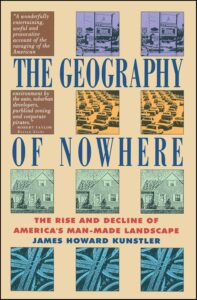
The subtitle, “The Rise And Decline Of America’s Man-Made Landscape,” is a good summary of this book, which is more informational than instructional, but the information is gold. “The Geography Of Nowhere” should be read by every urban planner and city/town leader in America.
After exploring the history of land ownership, the settling of America, and various wars, the author laments that this history resulted in “development” of land with little to no land-use planning. As a result, suburbia, which the author also calls the “automobile suburbs,” sprouted up as a uniquely American idea that neither the city nor the country was an appropriate place to live. The separation of suburbs from cities itself is not uniquely American. Louis XIV built Versailles 20 miles from Paris so that only the wealthy could afford to go there.
Architectural styles are discussed in detail, from Modernism, Bauhaus, Neoclassical, Art Deco, Postmodern, Georgian, Colonial, and Greek Revival and how events such as WW2 impacted the current “in” style. Have you ever wondered about porches? Victorian houses feature porches and encourage community, while Colonial houses do not feature porches and discourage community. (I suppose this is why we all hang out in the back yard and why various porchfests happen in the “old” parts of town.)
Cars are synonymous of American independence, and America had the auto market mostly to itself for a couple decade, while Germany and Japan worked to rebuild after WW2. More cars meant more development, which meant more roads, which resulted in the odd situation where we have public roads, built with public money, that are primarily used by private cars. The big US carmakers, and GM in particular, systematically worked to dismantle streetcars and replace them with gas-powered buses. Similarly, planners of roadways like the Van Wyck Expressway intentionally excluded rights-of-way for public transit.
Main Street used to be the center of people and places: where parades happen, for example. Now we have a suburban landscape where every place looks like every other place, and every place looks like no place. The 1956 Interstate Highway Act is the largest public works history in the history of the world, and it subsidizes those who can afford cars. Suburb roads look like Interstate roads (12-foot lanes) based on the assumption that it would be easier to clean up after nuclear war with wider roads. Sidewalks? Those are an afterthought, if a thought at all.
There are some positive example in the book, including Portland, Oregon, and farm land trusts in Vermont. So that’s good. But most leaders don’t consider the long-term implications of status quo development.
In short, cars should be part of the local transportation system, but they should not be the only option. Places like Kelley’s Corner in Acton? They are nowhere. There will be no parades or porchfests in Kelley’s Corner, it is a destination that a town cannot be proud of.
And if we look hard at Acton’s spending, much of it subsidies cars and traffic. Subsidizes AND prioritizes.
LEGAL DISCLAIMER & NOTICE: The “Sidewalks For Acton” campaign was started by and is funded by GiantPeople LLC, a single-person LLC founded in 1999 by Erik J. Heels (heels@alum.mit.edu). Erik is a small business owner, a USAF veteran, and has been an Actonian since 1995. Except for a one-year stint from 2024-2025, Erik has never belonged to any political party.